
Samsung Solve for Tomorrow
Power Up Design for the planet
Go straight to…
Overview
Great ideas don’t just solve problems – they protect the planet too. Sustainable design means creating things that use fewer resources, last longer and don’t create a lot of waste.
Samsung has made commitments to sustainable design “based on the belief that the environment is our future,” like:
To help reach these goals, professional designers ask questions like:
- What are the best materials to use for this product?
- How much energy will it need?
- What happens when it reaches the end of its life?
Thinking about these things makes your design smarter – and kinder to the planet. It’s also good business. A growing number of people want to buy sustainable designs, and many governments are starting to require them, too.
Case studies
1. Team Repair
| Challenge: | Phones and other gadgets are replaced often, creating tons of electronic waste. There is also a lack of diversity in the STEM workforce. |
| Solution: | Team Repair’s members saw these issues and created a solution to tackle both at the same time: kits that teach children how to fix broken electronic gadgets. The kits help children build confidence in their STEM skills and promote sustainable practices, like reuse and repair.
Team Repair was a 2022 finalist for Samsung Solve for Tomorrow and is now an award-winning company. In this video, Megan talks about Team Repair and sustainability. |
2. Treeva
 |
|
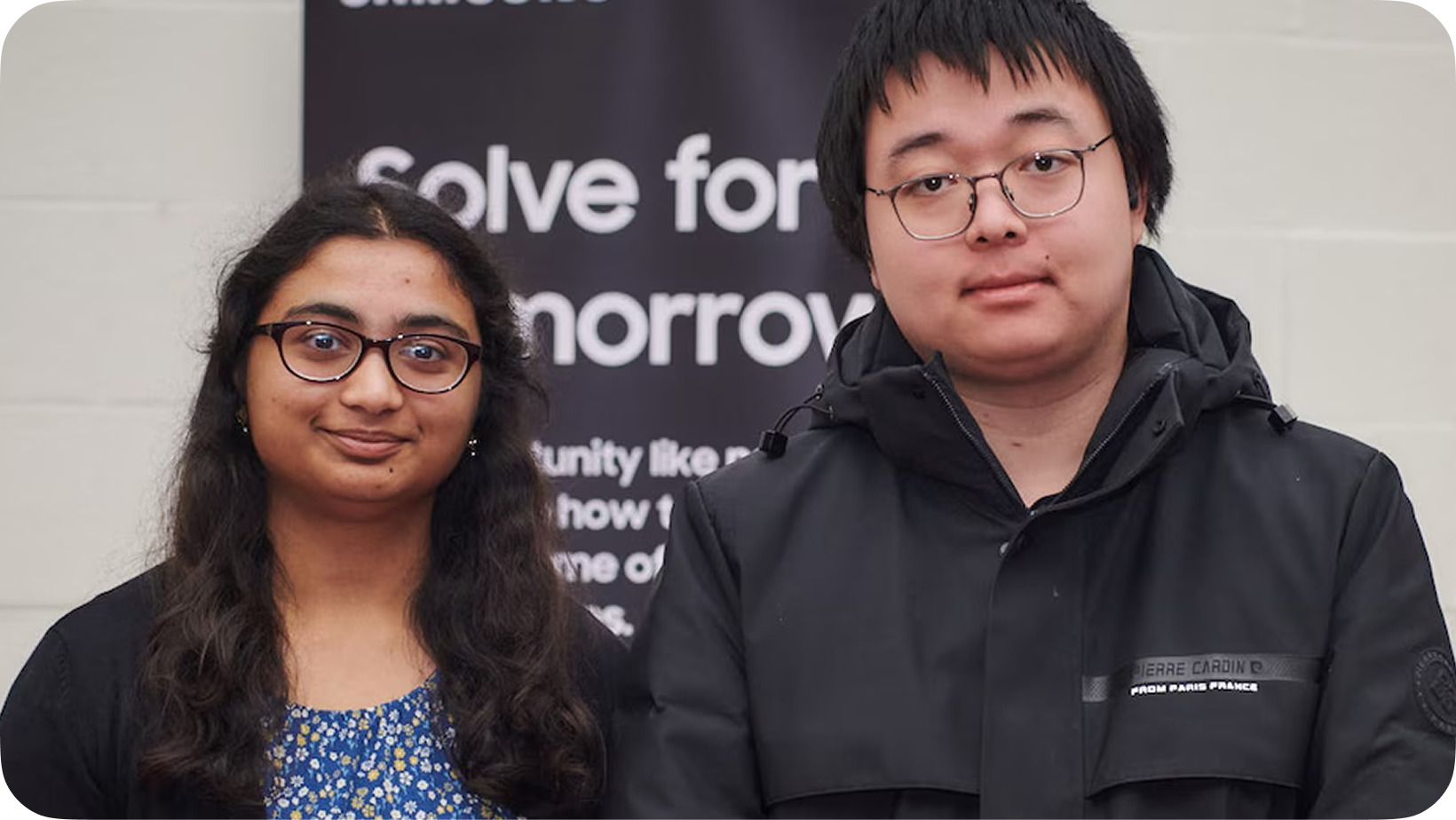
| Challenge: | Anjali is one of the creators of Treeva, and her family was affected by flash flooding in Kerala. Extreme weather events like this are becoming more frequent due to climate change. Anjali and her teammate, Yu, wanted to do something to help. |
| Solution: | Anjali and Yu’s solution, Treeva, won Samsung Solve for Tomorrow in 2024.
Treeva is a turbine device – like a windmill – that can be placed on the side of roads to harness energy from the breeze created by passing vehicles. This can be used to provide affordable, renewable power to the area and helps reduce the impact of transportation on the climate. |
3. Samsung Less Microfiber Filter
| Challenge: | Microplastics are eaten by birds and fish, and have even been found in the human body. An estimated 15% of ocean microplastics originally come from clothing. |
| Solution: | Samsung worked with Ocean Wise and Patagonia to launch the Less Microfiber Filter to collect microplastics shedding from fabrics, which allows them to be disposed of before entering waterways. The Less Microfiber Filter
This filter helps protect the health of people and wildlife and has won awards including TIME’s Best Innovations of 2023. |
Top tips on making your designs sustainable
These tips are inspired by the Design Council’s Skills for Planet Blueprint, which sets out the essential green design skills for creating a regenerative world.
1. Think about nature
- Ask: Will my idea harm or help the environment?
- Use fewer materials: Can you reuse materials or use recycled ones?
- Bonus: If your idea connects people with nature (like planting trees or reducing waste), that’s a win!
2. Cut waste
- Design for long life: Make things that last, not things that break quickly.
- Avoid single-use: Can your product be repaired or reused?
- If you need packaging, keep it minimal and recyclable.
3. Reduce carbon
- Choose low-energy options: Can your tech run on renewable energy or use less power?
- Think about transport: Can parts be made or sourced locally?
- Digital tip: Reduce unnecessary data storage or heavy files (less energy used in servers).
4. Include people
- Ask: Who will use this? Who might be left out?
- Make it fair: Design for everyone, including people who might not usually get access.
- Listen: If you can, talk to real people about what they need.
5. Make green choices easy
- Can your design help people make eco-friendly decisions without extra effort?
- Example: An app that reminds people to save energy or recycle.
6. Check your impact
- Ask: How will this idea help the planet and people?
- If you can measure something (like less waste or energy saved), even better!
- Keep improving: If you spot a problem, tweak your design.
Quick checklist for your idea
- Does it help nature? (e.g. avoids harm, uses recycled or renewable materials, or connects people with nature)
- Can it cut waste? (e.g. can it be repaired easily, reused, or designed to last longer?)
- Does it save energy or reduce carbon? (e.g. uses low-energy tech, renewable power, or avoids unnecessary transport)
- Is it fair and inclusive? (e.g. works for different people and doesn’t leave anyone out)
- Does it make green choices easy? (e.g. helps people recycle, save energy, or choose planet-friendly options)
- Can you check its impact? (e.g. measure something like waste saved, energy reduced, or people helped)
Career spotlight
|
|||||||||
|
“I am truly motivated by finding and solving problems in new ways, reducing the impacts of products and understanding the context around why they are created. The ‘design thinking’ process has become embedded into every aspect of my work. I was shocked to learn that plastic escaping fabrics when we wash and dry them is one of the biggest contributors of microplastics. I knew others would feel the same way and wanted to do something to solve this. As a team, we became experts in laundry microplastics and developed a new filter system. We made a working prototype and shared it internally to inspire the business. This is the best part of my role – learning things about people, their lives and the world that shock me and finding new ways to solve them.” |
|||||||||
|
|||||||||
|
“Sustainability shows up in our work every day. The industry has laws and regulations that aim to reduce emissions and help the planet. As a manufacturer, we play a big role in achieving this, like by creating products that use more natural refrigerants with a lower GWP (Global Warming Potential). This is important to me as a mother. I’m mindful to raise my daughter to care for the planet we live on. I hope if we all do our bit, there is a chance for a ‘greener future.’ Working in HVAC makes me feel that we’re making a difference. Our team has the best people in the industry, with tons of experience and genuine teamwork. Every day is like a school day, and you love your teachers!” |
|||||||||